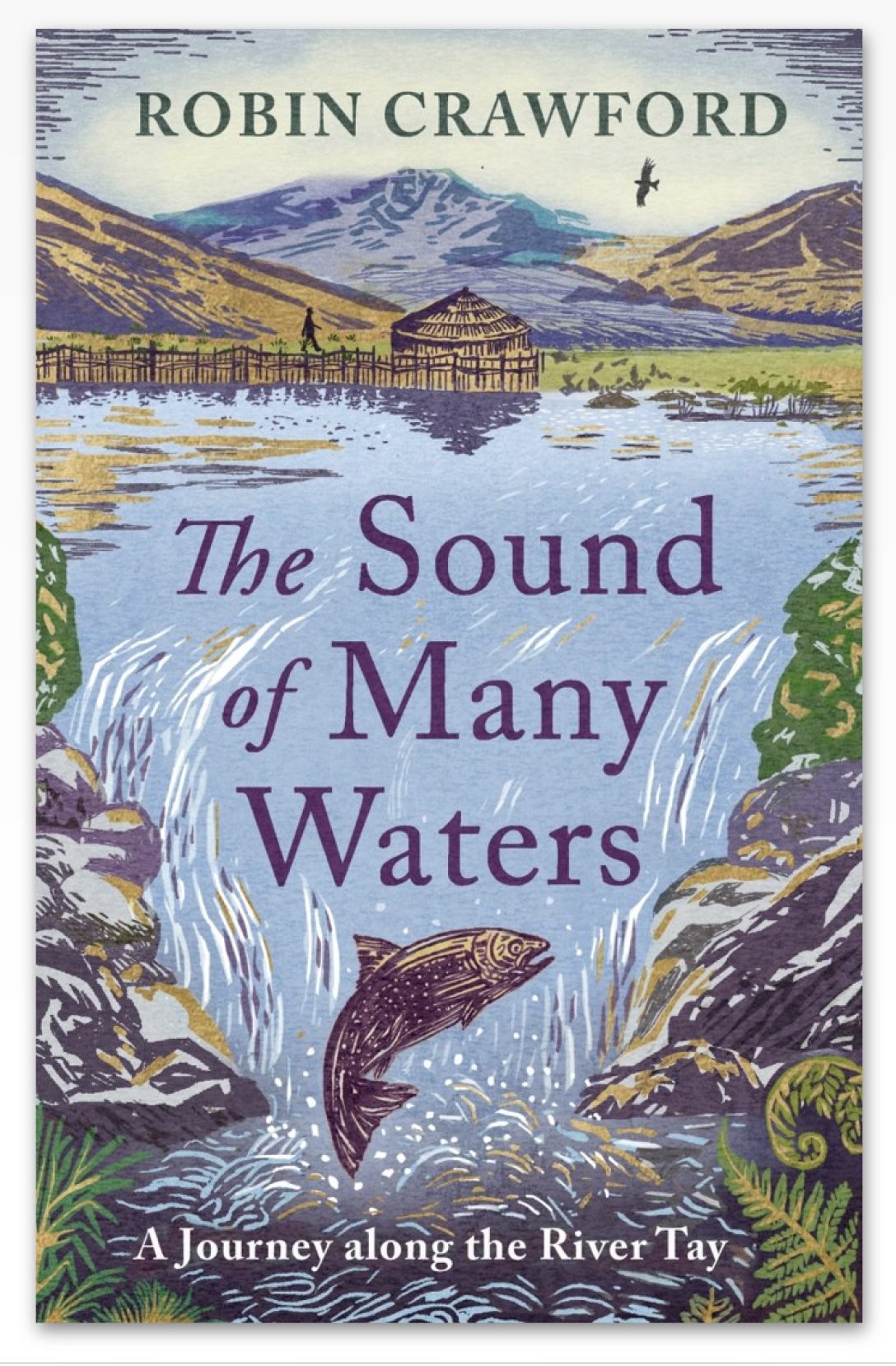
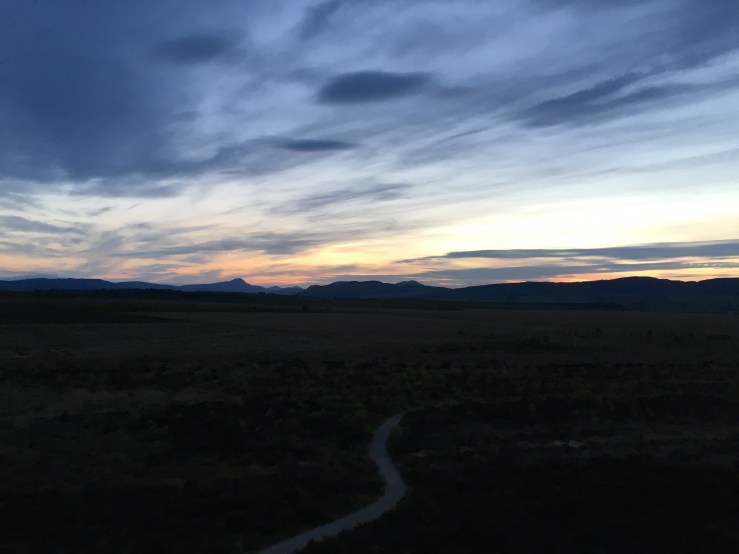
The moor.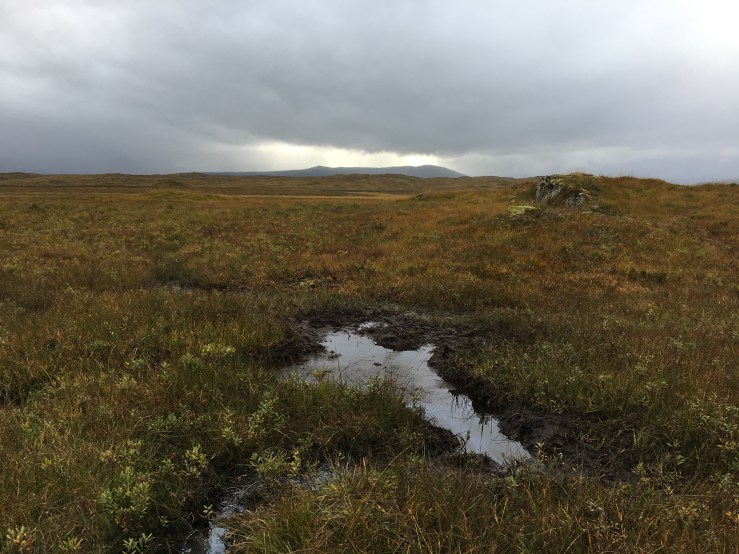
View from the bridge.
The view from the bridge. A mesh of ironwork and grills over the peaty burn flowing off the moor, part of an intricate interwoven watery grid of lochs, dams, tunnels and power stations that make up Scotland’s hydro-electric generating schemes. That power is delivered via wires and pylons back to the remote communities who still exist on the fringes of this moorland.
Bridge to the moor
After a journey where the road, woven to the loch-side hills, twisted, climbed and dived among the gold and jewel-coloured autumnal woodland like the mesmerising knotwork in the Book of Kells, at last…the bridge to the moor!
Discovered under a peat slab
An entry in ‘The Annals of Ulster’ of 1007AD reports that the “great Gospel of Columkille” (The Book of Kells) was stolen one night and discovered a few months later, stripped of its gold and jewel-encrusted cover, under a slab of peat.
Knotwork
Digging through my father’s student copy of Bain’s ‘Celtic Art: The Methods of Construction’ I unearthed some old student drawings of my own. Interwoven in the browning book pencil sketches of Pictish cavalrymen drawn from a decorated stone I’d come across in a field near Auchterhouse, Angus over thirty years ago. Re-reading its pages filled me with admiration for Bain’s painstaking deconstruction of the meandering, meditative but highly formal threads of ancient and early Celtic-Christian art. Even more so for the artists who made the originals, intricate student apprenticeships of stonecarving, weaving and illuminating techniques must have been just the first steps to creating such wonders. Once learned, there would have been the working out of the patterns; the compliance with the request of the commissioning lord or the correct doctrinal interpretation of scripture; the drawing from life the salmon, hunting dog or eagle that also informed the naturalistic representation of unnatural dragons and hellish monsters; the artistry of variation on a theme; the extra, undefinable magic that transforms craft into art.
The Pictish carver chipping away at the unimaginative stone must always have been alert to the intricacies of design but to do so they must have relied on an unthinking assurance of technique and habitual hard labour of using heavy tools.
I think of Seamus Heaney’s father and grandfather possessing this technical and physical ability:
“By God, the old man could handle a spade.
Just like his old man.”
In pre-mechanised days all workers needed these skills. The forester preparing the ground for the planting out of spruce on the Highland hillside with a massive rutter spade:
“In full flow a man in good working mode appeared as if he was sawing the peat along the line. The body, spade and its winged side tilted slightly sideways in the cutting direction, one foot and leg pumping the blade down, arms and upper body pulling up, all in continuous, fluid, repetitive movements enabled progression of several inches every stroke. This was the most arduous part of the operation and it took considerable strength, skill and endurance to man a rutter for a whole day.”*
I think of the scyther in Bruegel’s ‘Harvesters‘ twisting rhythmically, in front of him sprawled a fellow worker utterly exhausted by the repetitive, physical labour. Echoing half-dead man bundles of mown wheat are also laid out, the shape and regularity of newly dug graves- the place of final, eternal rest for all toilers in the fields, intricately reaped by that tirelessly practiced scythe-wielder, Death.
In other Flanders fields, my own grandfather- born near Auchterhouse- witnessed cavalrymen, dug trenches, meditated on the patterns created by the mass of regularly carved stones.
*http://www.forestry-memories.org.uk/picture/number194.asp
Timeless Digging
In his book ‘A Night Out with Robert Burns’ Andrew O’Hagan recounts watching the great Irish poet Seamus Heaney contemplating Burns’ father’s gravestone during a visit they made to Alloway Kirk. The image of Heaney’s own father from this poem ‘Digging’ springs into O’Hagan’s mind:
“Between my finger and my thumb
The squat pen rests; snug as a gun.
Under my window, a clean rasping sound
When the spade sinks into gravelly ground:
My father, digging. I look down
Till his straining rump among the flowerbeds
Bends low, comes up twenty years away
Stooping in rhythm through potato drills
Where he was digging.
The coarse boot nestled on the lug, the shaft
Against the inside knee was levered firmly.
He rooted out tall tops, buried the bright edge deep
To scatter new potatoes that we picked,
Loving their cool hardness in our hands.
By God, the old man could handle a spade.
Just like his old man.
My grandfather cut more turf in a day
Than any other man on Toner’s bog.
Once I carried him milk in a bottle
Corked sloppily with paper. He straightened up
To drink it, then fell to right away
Nicking and slicing neatly, heaving sods
Over his shoulder, going down and down
For the good turf. Digging.
The cold smell of potato mould, the squelch and slap
Of soggy peat, the curt cuts of an edge
Through living roots awaken in my head.
But I’ve no spade to follow men like them.
Between my finger and my thumb
The squat pen rests.
I’ll dig with it.”
Seamus Heaney, “Digging” from Death of a Naturalist. Copyright 1966 by Seamus Heaney. Reprinted with the permission of Farrar, Straus & Giroux, LLC.
Source: Death of a Naturalist (1966)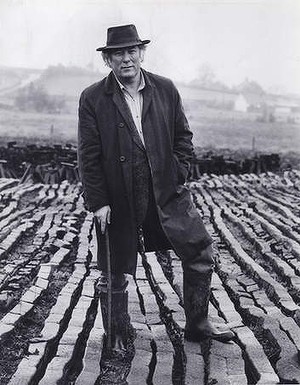
“It’s a sair chave- fur a haif loaf.”
“It’s a sair chave- fur a haif loaf.” detail of ‘The Harvesters’, 1565. Pieter Bruegel the Elder. Met, New York
Autumn comes early in the high peatlands
Autumn comes early in the high peatlands.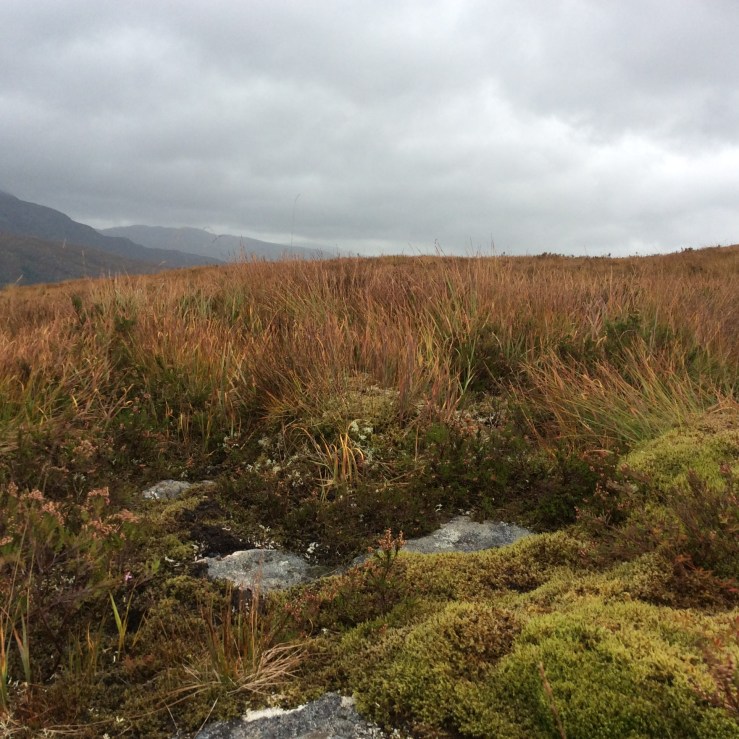
Autumnal boardwalk damselfly
Autumnal boardwalk damselfly.
Feith Mhoire
‘Feith Mhoire’
Ditch of Mary,
Ditch of Mary;
Heron legs,
Heron legs;
Ditch of Mary,
Ditch of Mary;
Heron legs under you,
Bridge of warranty before you…
“Flat moorland is generally intersected with innumerable reins, channels and ditches. Sometimes these are serious obstacles to cattle, more especially to cows, which are accurate judges. When a cow hesitates to cross, the person driving her throws a stalk or a twig into the ditch before the unwilling animal and sings the Feith Mhoire, Vein of Mary, to encourage her to cross, and to assure her that the bridge is before her.”
p.162 and p.613 ‘Carmina Gadelica’, Alexander Carmichael, Edinburgh 1899
 Robin A Crawford