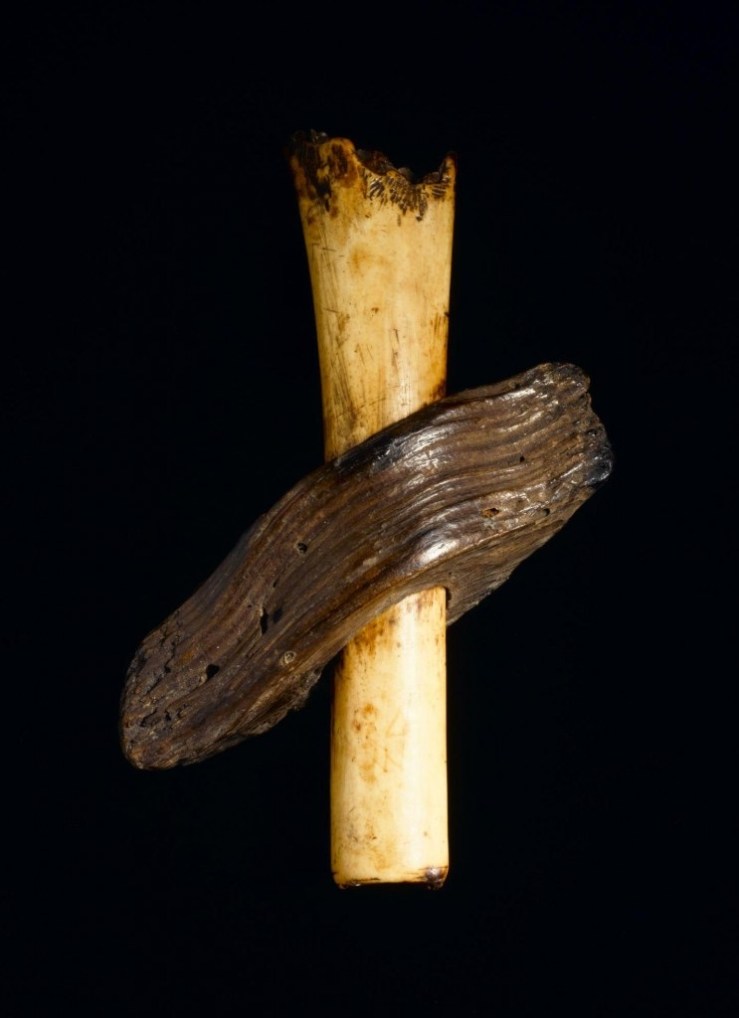
Witch’s cursing bone

Witch’s cursing bone. “A few years ago, the present writer came across a witch’s cursing bone…which had been the property of an old woman, a reputed witch, who lived near the head of Glen Shira, in Argyll, and who died there at the beginning of the present century [1900]. Such was her reputation that even after her death none of the Glen people would touch any of her possessions, and it was the minister…who found the bone upon the window ledge in her cottage. He took it away as a curiosity…in 1944 it was presented…to the Scottish National Museum of Antiquities.
“According to tradition, when the ‘witch’ wanted to ‘ill-wish’ a neighbour, she took her cursing bone and made her way to his croft between sunset and cock-crow. She did not go into the dwelling house, however, but made for the hen-house; and seizing the hen that sat next to the rooster (his favourite), she thrawed its neck and poured its blood through the hollow bone, uttering curses the while.
“The bone, which appears to be that of a deer, has been stained by age to a deep Ivory. It is enclosed in a ring of dark bog oak, roughly oval in shape. This is obviously a phallic symbol, to which the ‘witches’ we’re notoriously addicted.”

F. Marian McNeill, ‘The Silver Bough’ p.153/4 , Edinburgh 2001.F4B075CD-EDB2-4456-9423-C0E8BA12D702
National Museum of Scotland

Midnight sun at the shieling.

Midnight sun at the shieling.

“…She’s up all night till the sun,
I‘m up all night to get some,
She’s up all night for some fun,
I’m up all night to get lucky…
We’re up all night for some fun,
We’re up all night to get lucky…”

From ’Get Lucky,’ Daft Punk featuring Pharrell Williams and Nile Rodgers FBA87008-C2A1-47A9-9B26-6D6040BFEDE0

From Allan Ramsay’s ‘Gentle Shepherd’ illustrated by David Allan.

National Galleries of Scotland


Jane Welsh bakes a loaf for Thomas Carlyle


Living out on the high moor at Craigenputtock Farm, Dumfries in 1828 was Jane Welsh with her new husband Thomas Carlyle.
“I had gone with my husband to live on a little estate of peat bog that had descended to me all the way down from John Welsh the Covenanter, who married a daughter of John Knox. It was sixteen miles distant on every side from all the conveniences of life, shops, even post-office. Further, we were very poor, and further and worse, being an only child, and brought up to great prospects, I was sublimely ignorant of every branch of useful knowledge, though a capital Latin scholar and very fair mathematician. It behoved me in these astonishing circumstances to learn to cook! no capable servant choosing to live at such an out-of-the-way place, and my husband having bad digestion, which complicated my difficulties dreadfully. So I sent for Cobbett’s ‘Cottage Economy,’ and fell to work at a loaf of bread…”Leben Schillers

image:http://www.craigenputtock.org.uk/single.php?id=18

The Bog Strikes Back

The bog strikes back. The more the trees drink the water from the moss the bigger they grow but the less secure their roots are able to anchor in the peat. In conjunction with the “muckle forester”- the wind- the trees can be felled. This one on Bankhead Moss has tipped 45’ in the last four months.