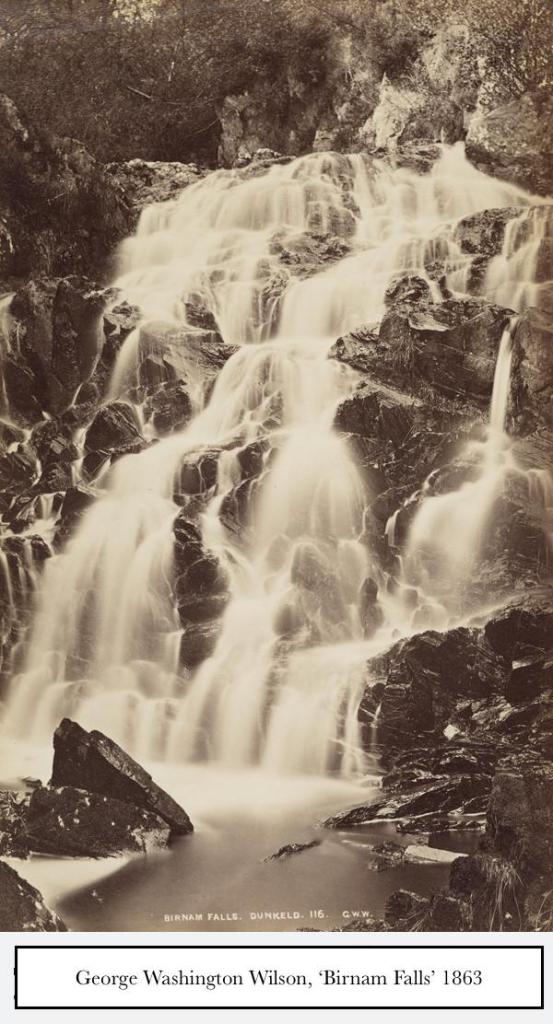
“George Washington Wilson is known for his Highland travel photographs and mementoes of Scottish excursions. His training as an artist informed the composition of his landscapes in the new medium of photography. While drawings and engravings illustrated the early nineteenth century travel guides to Scotland and provided regular income for Scottish landscape painters photographs were to replace them from the middle of the century. Wilson was a leader in developing this new form, his skill not only in replicating in liquid black and white chemicals the oil and pigment glazes or watercolour washes of paintings but exploring the possibilities of this new media and at an affordable price. In ‘The Salmon Leap, on the Tilt, Blair Atholl’ or ‘Birnam Falls, Dunkeld’ c.1860 Wilson structures the images as an artist would.
In ‘Birnam Falls’ at the top of the photograph a Highland cascade pours from a tree lined gorge; the waterfall is positioned in the centre; we view it from the pool looking up giving the impression of their height; the black solidity of the rock is contrasted with the white liquidity of the water. What the new medium offers though is the feeling of, and indeed the actual capturing of, time. While the ancient rock remains immobile the impermanent water flows. The real time process of uncovering the camera’s blackened lens and allowing light to flood onto the photographic plate captures the actual movement of the water in a way that most painting could never achieve. The blurred white of the falling water has an ephemeral quality separate from everything else in the picture, not only the immemorial rock but the seasonal delicacy of the leaves on the trees. The trees for a few decades will fringe the river – their trunks and twigs a thin, black reflection of the linn’s many branches – but they will rot and die. The photograph of the waterfall I take today standing where Wilson stood a hundred and sixty years ago captures exactly the same water, the same rocks though the surrounding vegetation is different. Where the free-falling water stops in the pool at the bottom of the image it changes tone as it slows, now fading to grey, neither still nor torrent but moving gently, easing our eye out of the picture and on, like the river, beyond these moments with the course of our journey. The sensation of movement captured in the photograph thrilled Victorian viewers and was developed further by innovations such as stereoscopic cards where double images placed side by side gave a binocular feeling of depth and space such as his ‘Fall on the Braan at the Hermitage Bridge, Dunkeld’ of 1863. By the 1880s Wilson was further experimenting, printing his images onto glass plates that were then hand coloured and could be viewed as ‘magic lantern’ slides, Wilson himself, presenting lectures to accompany a showing. By the time of his death in 1893 his photographic publishing firm was employing 40 people and accepting images from photographers from all over the world, his only rival operating on the same scale was James Valentine in Dundee.”
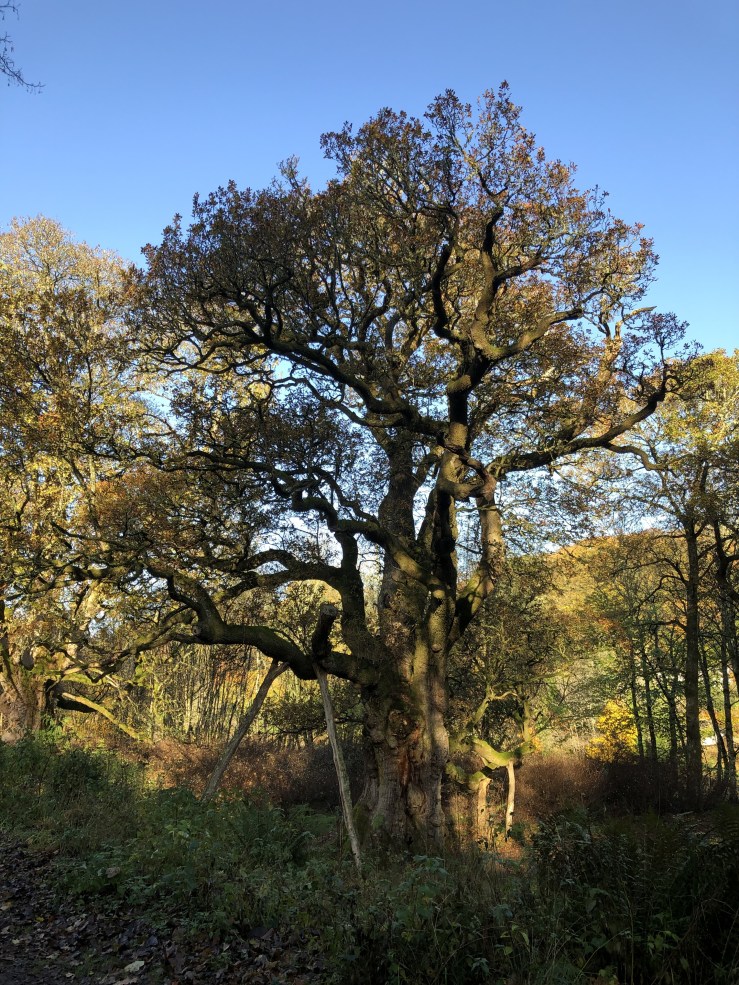
MacBeth was king of Scotland from 1040-1057. This ancient tree on the banks of the Tay at Birnam is associated with him. If not planted when the real MacBeth was king, it certainly was growing here when a travelling troupe of English players- perhaps including Shakespeare himself- visited Perthshire in 1599.
Places we now associate with Shakespeare’s play- Birnam Wood, Glamis and Dunsinane- all lie within the Tay’s catchment.
Another tragedy is taking place before our eyes. In the photograph above you can see that the branches of the tree are having to be supported. Human intervention along the river is causing the land around the tree to flood, undermining it. Without drastic action this mighty oak, like a slain king, will fall.
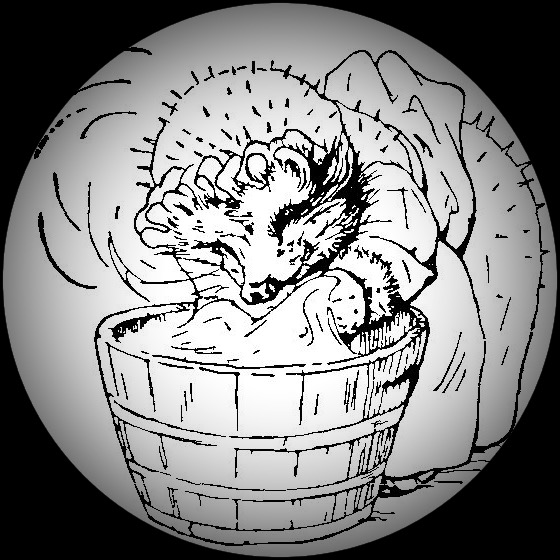
Wash. Rinse. Repeat. Beatrix Potter based ‘Mrs Tiggy-winkle’ on Kitty MacDonald, a washerwoman from Inver on the Tay. One of the many sounds along the river has been that of generations of poor women’s feet trampling in washtubs, their red raw hands beating laundry against river rocks, their fingers rasping on ribbed washboards.
Victorian holidaymakers to the Tay like Beatrix Potter would pass their stained clothing to local laundresses to be washed in its pure waters in basement rooms, outhouses or in tubs by the river. Potter dressed Kitty in 19th C. clothes but chose to depict her as a hedgehog, a small, timid creature but with prickly defences – an eater of slugs, different from them. “The Scotch,” she wrote were “tolerable savages.” Kitty was not just small, she was stunted from an orphaned childhood of malnutrition and a life of poverty.
150 years later Potter’s books are as popular as ever, what does that tell us about the attitudes to those who service the needs of tourists along the river today? Wash. Rinse. Repeat.
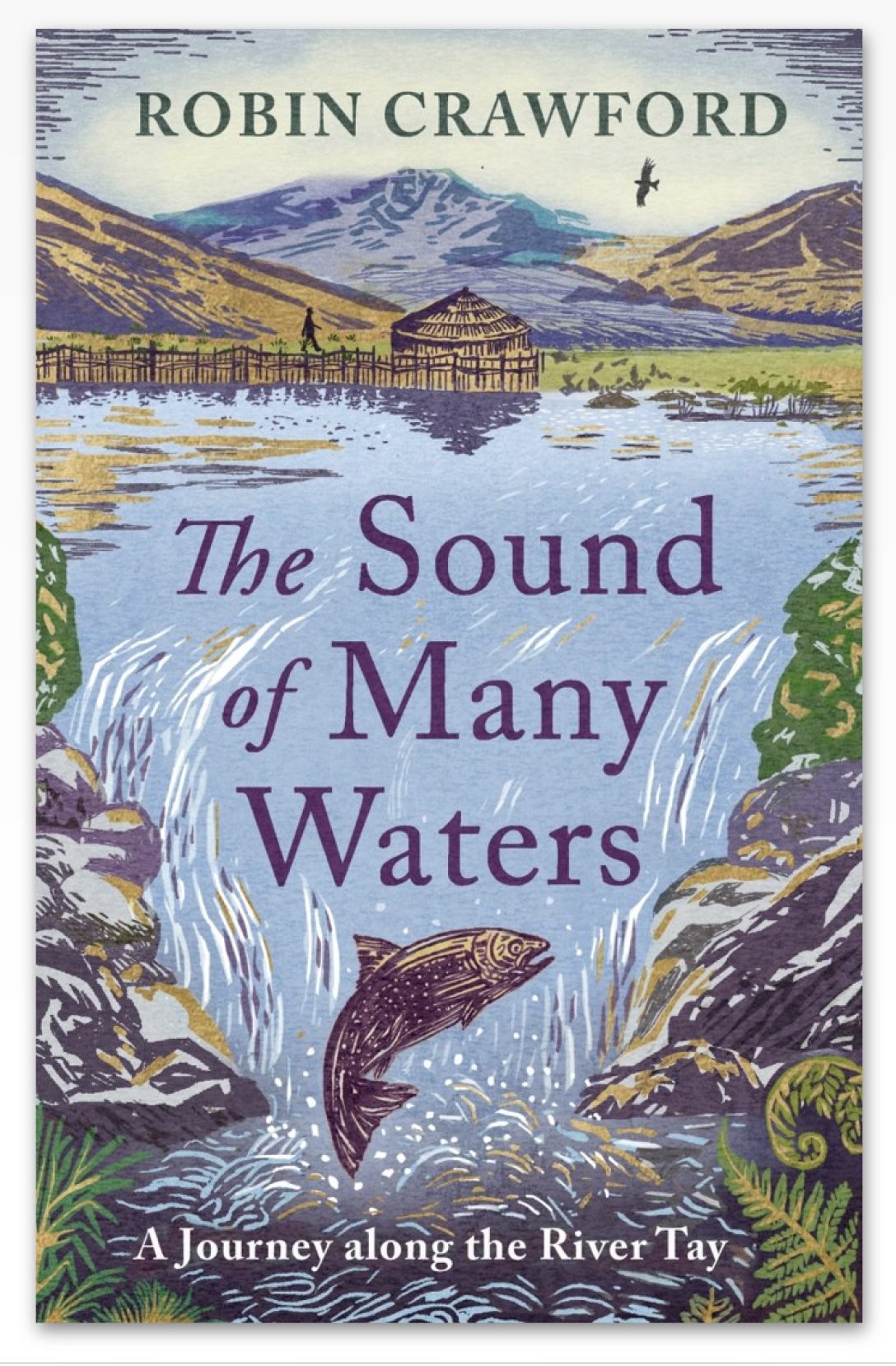
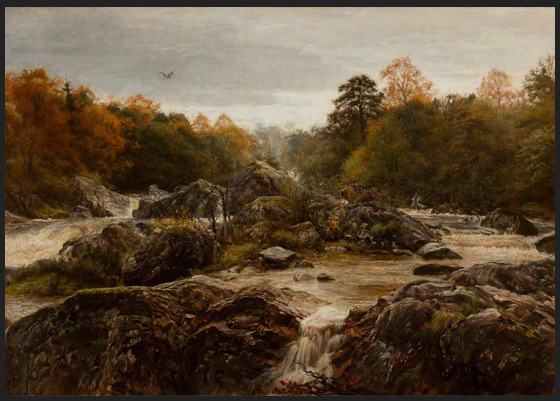
The title of my new book comes from this riverscape by Sir John Everett Millais. It was painted near Dunkeld, Perthshire in 1876. Millais, the leading English painter of his day, has many connections to the Tay not least through the pre-eminent Victorian art critic John Ruskin. Ruskin was a champion of his art.
Ruskin’s family had lived at Bowerswell House overlooking the Tay in Perth, later it was owned by the family of Effie Gray. Ruskin and Gray married in 1848.
Ruskin had invited the Pre-Raphaelite painter from London to holiday with him and Effie in Scotland. Though painted later there are suggestions of autobiography in the picture. Against the background of the Ruskin’s unconsummated marriage the wild torrent of the upland river roars over the twisted geology of the petrified Highland rocks. As the season changes among the riverside trees the raging passions alter in the trio’s relationship. Millais and Gray fell in love. After the Ruskin’s marriage was annulled they married, Effie giving birth to eight children.
The upland river cascading over rocks, in the eagle above can you see the painting’s composition reflected in the cover of the book?
‘The Sound of Many Waters’ 1876 by John Everett Millais (1829-1896)

 Robin A Crawford