bog-cottongrass knot.
Peat bank bricks
Peat bank bricks.


Water of life/water of death
Water of life/water of death
Alcohol-related deaths in the Western Isles ‘more than twice the Scottish average’
David Ross
Highland Correspondent
‘The Herald’
21st October 2015
“Concerns have been raised about health attitudes in isolated communities after new figures show the rate of alcohol related deaths in the Western Isles is more than twice the Scottish average.
Last year 15 people died from amongst the 27,400 people who live in communities from Lewis in the north to Barra and Vatersay in the south, compared to eight the previous year.
It means 2014 is the highest figure in decades despite the NHS Western Isles and the Outer Hebrides Alcohol and Drug Partnership launching a major awareness campaign in February of that year “Drinking too much…is it worth the risk?”
Last year’s figure represents a rate of almost five and a half alcohol-related deaths per 10,000 people.
This compares to just over two for Scotland as a whole and two and a half for Glasgow and Greater Clyde, the next worse health board area.
The rates for the rest of the Highlands and Islands are far lower. NHS Highland, which also embraces Argyll, is a little over two, while Orkney had fewer than one and a half per 10,000 as did Shetland.
The figures come from the National Records of Scotland and the SNP MSP for the Western Isles Alasdair Allan, said they were deeply concerning.
Mr Allan, the Minister for Learning, Science and Scotland’s Languages, said: “These figures are a sad reminder of the dangers of excessive drinking, and why it is so important for us to face up to the realities of Scotland’s drinking culture.
“I am certainly not against people enjoying a drink, and would support the responsible enjoyment of alcohol. However, statistics like this should be a wake up call for us all.
“The human cost of alcohol abuse here in the Isles, and across Scotland, is immense. Each alcohol-related death represents a tragedy for that individual’s family and a loss to society that could have been avoided.
“All this makes me more convinced than ever that the Scottish Government is doing the right thing by pursuing measures to clamp down on the availability of ultra-cheap forms of alcohol, despite the efforts being made through the courts from some quarters to maintain the availability of some forms of alcohol at prices that compete with bottled water.”

Alcohol Research Group, University of Edinburgh,1995. Anderson, Kellie. Alcohol, tobacco, illicit drug use and sex education among teenagers : a report for the Western Isles Health Board. Alcohol Research …
Elixir or water of life.
Elixir or water of life.
“In the North and West,…pure whisky, deriving its flavour from moss-water, peat and barley malt and from nothing else, first came into being and its high qualities were first recognised.”
p.57 Aeneas MacDonald, ‘Whisky’, Edinburgh 1930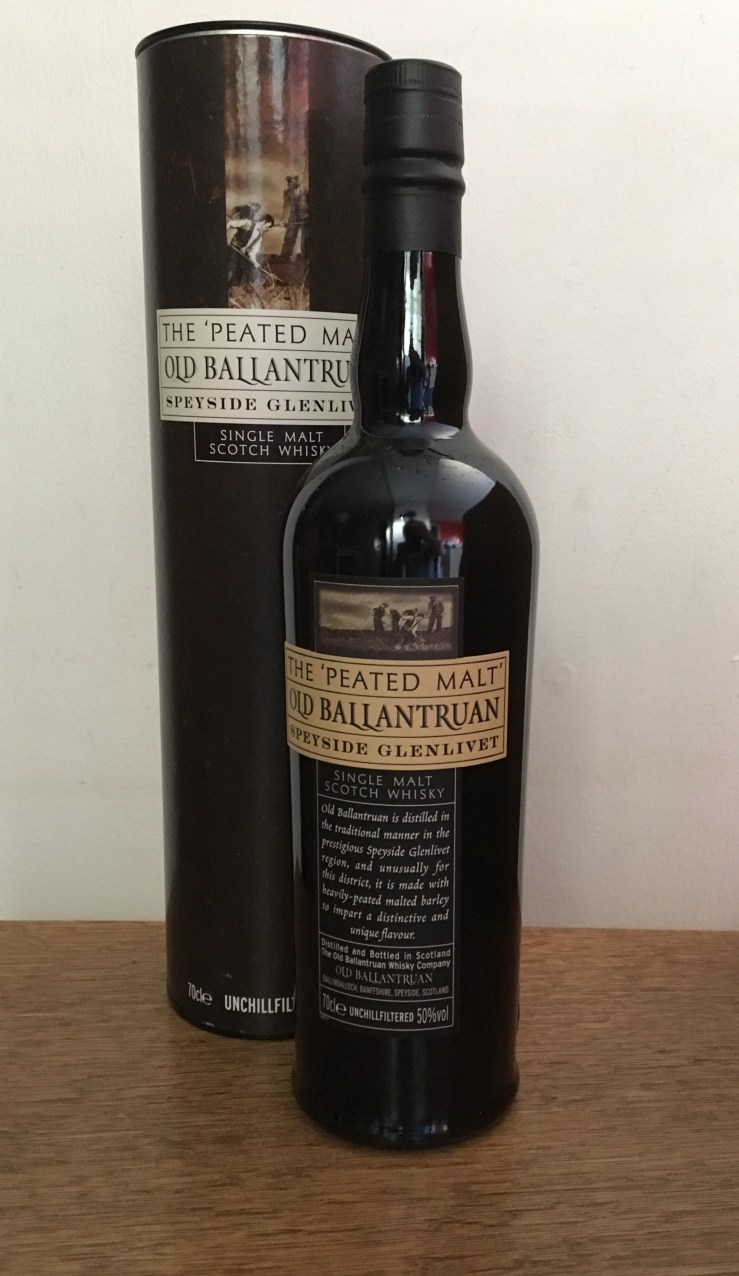
Underground is a place of “enchantment” and “magic”.
Buried deep within Scotland’s cultural life is a world underground. It’s a place of “magic” that “can thrill you through and through”; “there’s places far away like a song that’s sweetly sung” but “unless you looked you’d never notice it at all”.
“There’s Partick Cross and Cessnock, Hillhead and Merkland Street,
George’s Cross and Govan Cross where all the people meet
West Street, Shields Road, the train goes round and round
You’ve never lived unless you’ve been on The Glasgow Underground.”
From the 1950s to 90s music hall duo Francie and Josie would take you to a world free from the everyday troubles of city toil and strife to a wonderful, happy, care free place- perhaps elixir-fuelled.
“I know a lot of folks go to fancy places at the Fair,
They like to sail on steamers or go hurtling through the air
But I’ve a favourite route that goes to many ports of call
Although unless you looked you’d never notice it at all
Chorus:
There’s Partick Cross and Cessnock, Hillhead and Merkland Street…
They tell me that Majorca is a dandy place to be
Or Switzerland or Italy or even “gay Paree”,
There’s many lovely beauty spots upon the Clyde of Firth
But I would rather always travel doon below the earth.
Chorus:
There’s Partick Cross and Cessnock, Hillhead and Merkland Street…
There’s names that ring like magic that can thrill you through and through
They seem to call you back wi’ an enchantment never knew
There’s places far away are like a song that’s sweetly sung
You’ll roll them round your mooth and feel them slidin’ aff yer tongue.
Chorus:
There’s Partick Cross and Cessnock, Hillhead and Merkland Street…
I never liked the stourie winds, the showers or the snaw,
The sun can get too burny and the sleet’s no nice at a’
But I don’t mind the climate now as on my way I go
The dolce vita’s waiting there a hundred feet below.
Chorus:
There’s Partick Cross and Cessnock, Hillhead and Merkland Street,
George’s Cross and Govan Cross where all the people meet
West Street, Shields Road, the train goes round and round
You’ve never lived unless you’ve been on The Glasgow Underground.
‘The Glasgow Underground Song’
performed by Francie and Josie
written by Cliff Hanley


looking (on) glass…
“A man that looks on glasse,
On it may stay his eye;
Or if he pleaseth, through it passe,
And then the heav’n espie.”
from ‘The Elixir’ by George Herbert (1593-1633).



“…sank into a deep hole out of sight.”
The eternal flame of the soul burning forever in glory is represented by inverted torches on the sides of my great, great grandparents gravestone in Alyth cemetery, Perthshire. In life- or at the times these portraits were taken- Barbara Duncan and Alexander Mitchell looked like this:-


But I never heard their voices, and can only now very occasionally remember the voice of my dear grandfather who was born here in Alyth, and who, aged seventeen, helped bear his grandfather’s coffin to this grave.
Opposite are more recent gravestones which have photographs on the headstones. I recognise one. It is of Belle Stewart, the traveller singer, the ‘Queen Amang the Heather’. Her voice I heard, singing ‘The Berry Fields o’ Blair’ at Dundee in the early 80s. I can imagine her in my head or with a couple of swipes of my finger on my iPad I am listening to her singing now as I type this.
In Alyth Museum I recognise another face, the fine bronze bust of a fine man, Hamish Henderson- illegitimate, soldier pioneer, intelligence officer, poet, political activist, translator, bisexual, collector of stories and songs …and singer. Another swipe of the finger and he’s singing a duet with Belle Stewart, ‘The Overgate‘. n.b. The Overgate is a road in Dundee, the higher of two streets or gates (from the Norse “gata”) which run either side of the city church, the other being the Nethergate, the lower street. High road and low road.
All of these people lived long lives into their eighties, their nineties even, but on the Mitchell gravestone a short life is commemorated:-
“James
who was drowned in the River Isla
25th Jun 1876 aged 14 years.”
He died rescuing his younger brother from drowning. ‘The Dundee Courier and Argus‘ reported how he moved from safety to danger:
“GALLANT DEED AT ALYTH.
BOY SAVING A BROTHER’S LIFE AND LOSING HIS OWN.
Three sons of Mr. Mitchell… went into the water hand-in-hand, and by some means one little boy…sank into a deep hole out of sight. His older brother, James (14), seeing the little fellow thus likely to be drowned, plunged down to the bottom, though he could not swim, and with a heroism worthy of the stake at issue, crept on his hands on the bottom of the pool, seized hold of his brother, gave him a vigorous push out of the place towards the shore, which had the desired effect in saving him, but most unfortunately James, the gallant hero of the noble deed, sank himself, and was drowned…the younger Mitchell, who for some time appeared in a critical position, but he recovered. Numbers soon appeared at the water’s edge, and by the aid of creepers pulled out the body.”
The younger boy was Charles and at the end of a long life he commissioned this stained glass window to be installed in Alyth Kirk.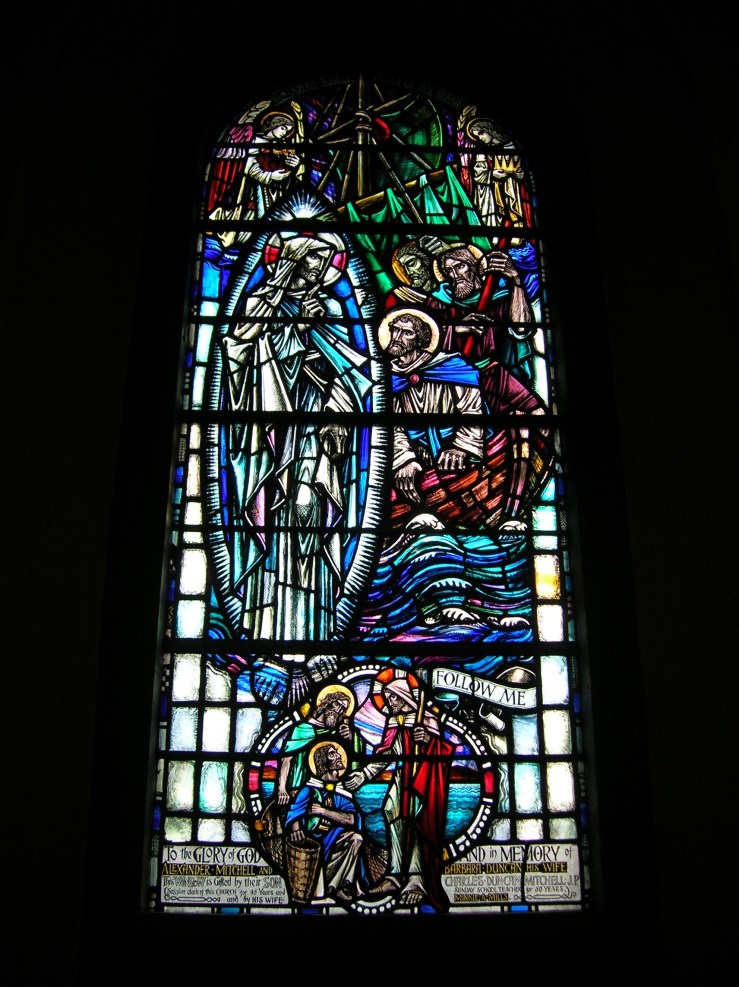 Christ walks on water before his own sacrifice.
Matthew 4:16
“The people which sat in darkness saw great light; and to them which sat in the region and shadow of death light is sprung up. 17From that time Jesus began to preach, and to say, Repent: for the kingdom of heaven is at hand. 18And Jesus, walking by the sea of Galilee, saw two brethren, Simon called Peter, and Andrew his brother, casting a net into the sea: for they were fishers. 19And he saith unto them, Follow me, and I will make you fishers of men. 20And they straightway left their nets, and followed him.”
Later, standing on the bridge over the Isla the river, like time, slips by. The peaty mountain water glints over the golden gravel shallows in the August sun before it flows into shadow and unknowable depths and currents. Firmly anchored on the solid stone bridge it is disconcerting to watch the liquid water, flickered by the cooling and momentary flames of evening sunlight, moving under your feet. I think of James who thrashed from life to death in this water, from the earthly paradise of youth and the brink of manhood to such a sudden ending. And of another gravestone, in Poussin’s painting the pastoral shepherds of Arcady are shocked to discover in their earthly paradise a tomb, tracing with their fingers the inscription, “Et in Arcadia ego” (even in this paradise, I, Death, hold sway). Some Northern European peatland societies drowned sacrificial victims out on the moors believing they would propitiate their gods but now some of these mummified ‘Bog People’ have been resurrected to a macabre afterlife in museums.
Standing before a headstone has its own macabre sensation. To read the inscription, especially on an old weather- and time-beaten one necessitates walking over the grave or graves. The ground underfoot is uneven, it has been dug- and on a family lair, redug- many times. What was once solid, diminishes; spaces alter; transformations in substance and material take place. One is never quite sure that the ground will not suddenly give way, a deep hole could open up, you may sink out of sight and be swallowed up by the grave. All the more disconcerting, all the more frightening, as we know that with certainty Death- coming suddenly or not- will claim us all.
Footnote: On a bitterly cold February day my son Alexander and I visited the Mitchell family grave where clumps of white snowdrops heralded a resurrection, of sorts.
unstacking
“A most extraordinary occurrence was reported in The Gazette, 19th June 1830 near the Braes of Crombie in the North East of Scotland when a whirlwind picked up a whole peat stack amongst other thatched roofs, etc. witnessed by a lady from her carriage, and, from its very extraordinary appearance, seemed at first like a numerous flock of crows at one of their gambols.”
Underground
Under the ground. Under the peat. Pink clay under Gordon Moss, Berwickshire.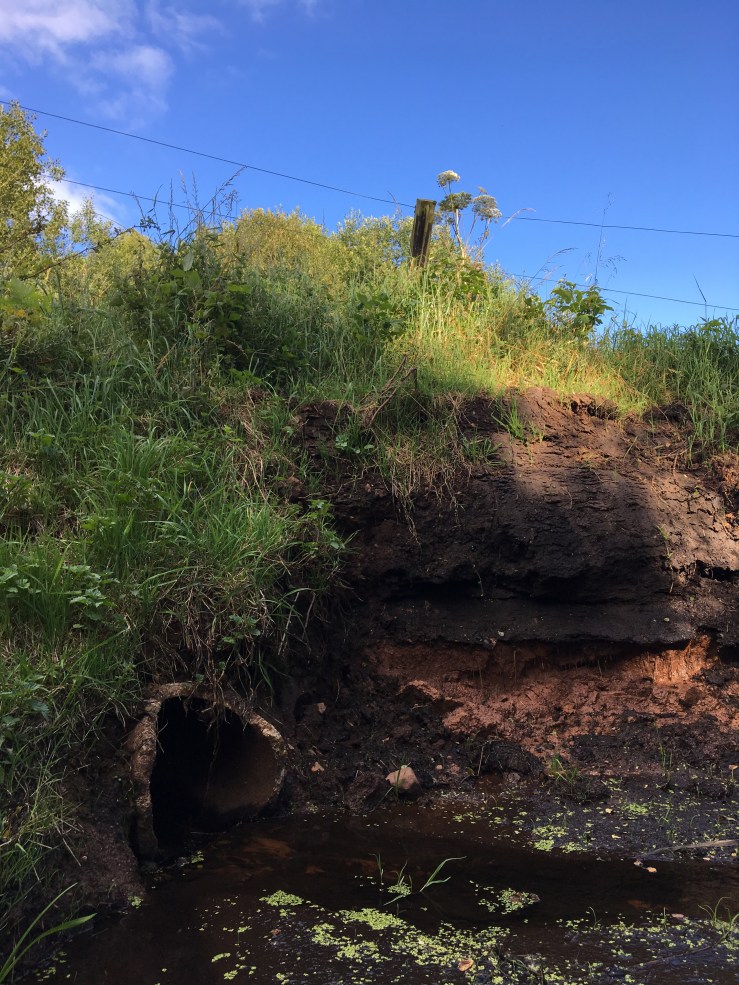
Rutter: Herring bone peat
Foresters would prepare boggy mountain-sides for planting by digging regularly spaced ditches nearly horizontally along the contours until they joined a main drain running vertically down the slope, giving the hill a herring bone pattern. Working in teams of three the first digger used a rutter spade to mark out the lines of the ditch; the second used a cross cutter spade to cut and prize the turf off; and the third would use a three-pronged ‘howk’ to toss the turves alternately left and right either side of the drain. The upturned peat turves would chequerboard the hillside, two lines above each drain, three lines below. When it came to planting the turves would be cut and a sappling planted in the centre.
 Robin A Crawford