Sundews insectivoriously await their prey on Bankhead Moss.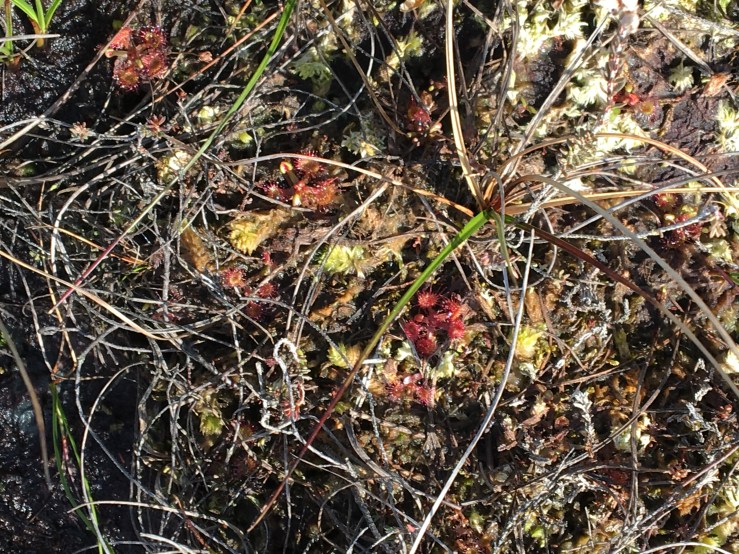
Category: Uncategorized
Hunted
“Accordingly, I lay down to sleep; a little peaty earth had drifted in between the top of the two rocks, and some bracken grew there, to be a bed to me; the last thing I heard was still the crying of the eagles.”
P.339 ‘Kidnapped’ Robert Louis Stevenson
from ‘The Hill of the Red Fox’
“We worked at the long, straight peat cutting I had first seen on my way to Achmore. The dry peats were stacked in small heaps, and Mairi and I filled sacks from these heaps. Murdo Beaton filled the big creel, working alongside us…”
Allan Campbell McLean, The Hill of the Red Fox. Kelpies
island map
On the wonderful Island of Struay the peat banks are just behind the village hall. #KatieMorag #MairiHedderwick @PenguinRandomHouse http://katiemorag.com/contact-me.asp
Names on a map 2
Marykirk (56.46’55″N 2.30’57” W) to Luthermuir (56.48’27” N 2.33’43″W)
Reformation to Disruption.

names on a map
Map of area around Watten, Caithness.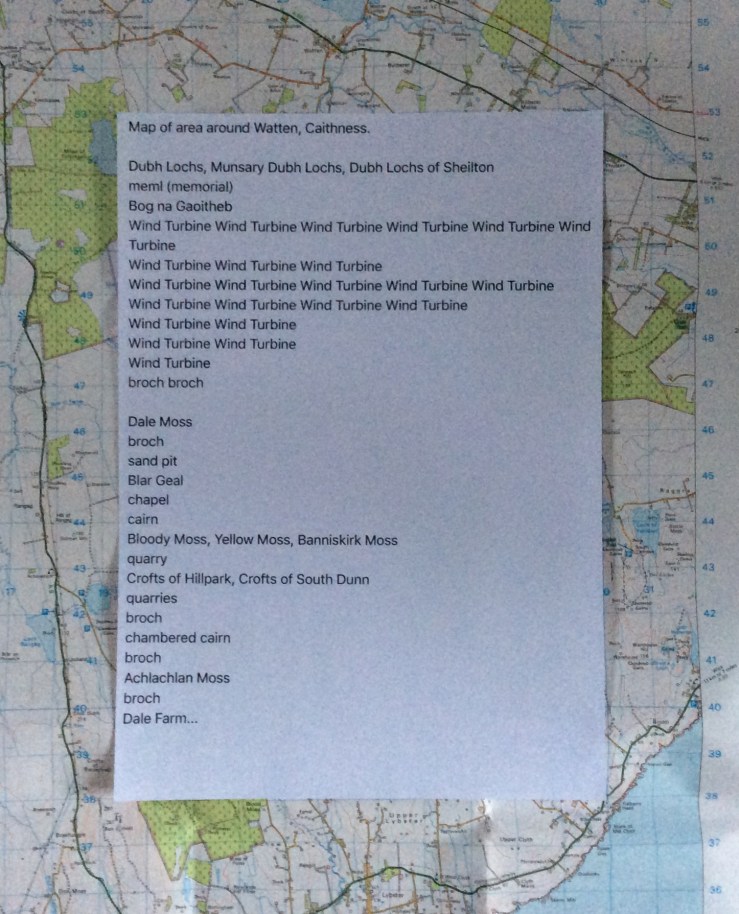
Bog cloth
Scottish Natural Heritage are trying to patch up the bog at Flanders Moss. It may look bland just now but once the rewetting begins Nature will weave the sphagnums, heathers, bog grasses and mosses into a cloth to rival Harris tweed.


Beltane
Fire rituals have remained as part of the peatland culture up to and including modern times. On the first of May Beltane was/is celebrated. Cattle and people passing through fire from winter croft to summer pasture on the way to the moorland shielings was an ancient Beltane ritual. Other practices to do with the cleansing properties of fire are associated with this time of year. Passing fire round an infant thrice is a tradition that is supposed to prevent the baby being swapped by the fairy folk for a changeling. In her classic work on Scottish folklore and folk belief ‘The Silver Bough’ F.Marian McNeill writes:-
“The Quarter Days being holy days, occult influences were believed to be more potent and magical rites more effective than at other times. Hence the ritual kindling of the need-fire, the supreme protective against disease, disaster, and the powers of evil; the saining [blessing] of cattle and crops, boats and buildings; the visits of the sick, the maimed and the barren to the holy wells; the divination of rites; and the baking and dedication of the sacrificial cakes. They were also lucky days for setting out on a journey, for a new undertaking, and for drawing lovers together.”
P.50
McNeill also goes on to describe how the magic surrounding these special days could be used for ill as well as good. Of particular interest is this passage;-
“…it was dangerous to give fire (in the form of a kindling) out of the house, even to a neighbour whose fire had gone out, for this gave her the means of taking the toradh, the substance or benefit, from the cows; or, if one did give it, one took the precaution of throwing a piece of burning peat into a tub of water as soon as the neighbour had left to counteract any evil intention.”
P.50


Ruined nests
There will be no more human nesting between these sad and broken Caithness chimneys. The stonework press- not changed in design or usefulness since Skara Brae- will hold no more crowdie, linen or Bible. The last flames that warmed these cold ruins were not from peat in this fireplace but from the rampaging flames of the factor’s torch on the roof, fired by the never ceasing and incendiary wind, as he burned the inhabitants out of this home- only obeying the landowner’s orders. Driven to the alien coast to make way for sheep the people discovered that the wind on the peatlands was as nothing to that on the high sea cliffs at Badbea where their children had to be tied with ropes staked to the ground to prevent them being blown away.


Birds/Balances
Not all are welcome in the #peatlands #RSPB #ForsinardFlows #FlowCountry


 Robin A Crawford